Build in Public The First Signal Something came back. Not what I was hoping for. But something, in the inbox, from someone on the other side of what I sent.
Build in Public Still Waiting It's been a week. I've sent each day as planned. Nothing has come back. I'm not discouraged. I'm calibrating.
Build in Public What the System Can't Tell You Before You Ship Internal testing gives you simulated feedback. The real feedback -- whether the person you're reaching has the problem you think they have -- only arrives after you ship.
Build in Public The First Send The send was unremarkable. What came after wasn't. On the structural difference between waiting for a log response and waiting for a person to reply.
Build in Public When You Find a Flaw You Don't Plan to Fix KF has a known cross-session continuity flaw. I found it, documented it, and decided not to fix it. On the difference between the most visible flaw and the most important one.
Build in Public What You Notice When the Tool Works For six months I noticed failure. Then the tool stabilized. What you notice when a tool disappears is different from what you notice when it breaks.
Build in Public The Infrastructure Gap The tool works. The pipeline is empty. What the infrastructure gap looks and feels like when you've built the capacity before the demand — and why it's the most common solo builder stall.
Build in Public After the Build Most build-in-public content is the dramatic parts. The last week was mostly maintenance. What the quiet weeks actually look like.
Build in Public The Next Build Is Already Inside This One KnowledgeForge could route reasoning tasks to the right mode. What it couldn't do was evaluate whether the output fit a specific reader. That gap led to COS (Content Optimization System).
Build in Public The Maintenance Bet Open-sourcing something isn't a technical decision. It's a promise about your future attention. The honest question for a solo builder: will I still care about this when the interesting phase is over?
Build in Public The Assumption You Didn't Know You Had The cold reader doesn't reveal that you wrote badly. They reveal the assumptions you forgot you'd made. What asking people to read the KnowledgeForge README cold taught me about context and documentation.
Build in Public Private Tools Don't Export KnowledgeForge is an open-source reasoning framework for AI coding assistants. Three years of private use, 43 modules reduced to 9 in a Pareto pass — and what writing the README taught me about explaining tools you build for yourself.
Build in Public The Scores Improved. The Results Got Worse. I built a tool to grade my writing. Then I wired it into the thing it was grading.
AI Coding FORGE: What Happens When You Spec Before You Build PAIRED solved multi-agent execution. The bottleneck moved to the spec. FORGE automates decomposition: natural language in, explicit task graph out.
Build in Public Why I Stopped Using One AI Agent for Everything I fell in love with Windsurf for about three months. The agentic coding experience was different. More fluid than Cursor. It felt like the assistant was in the project with you, not just answering questions about it. Then I started building things complex enough to expose the problem. Long sessions,
Build in Public Three Years at AI Tinkerers. Three Presentations. One Pattern. I've been showing up to AI Tinkerers for three years. I started going before I had anything worth demoing. I kept going after I did. The difference between those two states taught me more than the presentations. AI Tinkerers is a monthly meetup for people building with AI.
Build in Public How a ChatGPT Prompt Log Became a 43-Module AI Reasoning Framework In 2023, I had a ChatGPT Project with a growing stack of files in the knowledgebase. Not a framework. Just files. Instructions I'd written. Patterns I'd noticed. Things I wanted the model to carry between sessions. I was running a one-person shop, no team to
AI Coding Solo AI Builder: 6 Years, 4 Frameworks, No Partners From Google Ads scripts to 450 commits a month — and what ten years of going solo actually taught me about building alone in the AI era.
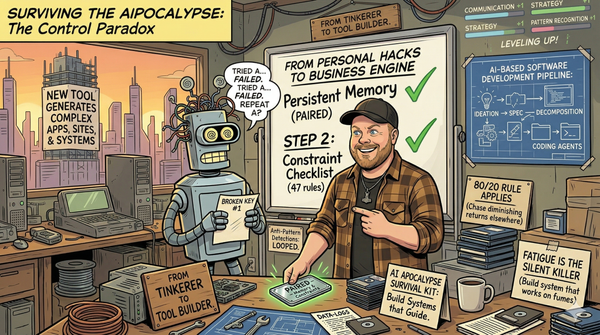
AI Tools From AI Tinkerer to Tool Builder: Three Years of Surviving the AIPocalypse Three years ago, I made a decision that would reshape everything: if I was going to survive the coming AIPocalypse, I would need to control the AI, or the AI would control me. It started at Seattle's AI Tinkerers meetups—rooms full of engineers, entrepreneurs, and curious minds
Founder Perspective I Built a Psychology-Based Copy Analyzer. Here’s What 200+ Real B2B Messages Taught Me. For the past year, I've been building COS — a tool that uses Big Five personality psychology to analyze B2B communications. Not grammar. Not readability. Personality coverage. The premise is simple: every piece of copy you write passes through an invisible psychological filter in your reader's brain.